


What is Molecular Geometry ?
Molecular Geometry is basically the three dimensional arrangement / shape / structure of atoms that form a molecule. When molecules are formed by chemical bond which means atoms bonding together, suborbitals involved in the bond or bonds create different molecular shapes depending on many factors.
For example, the water molecules are not linear, a water molecule is actually ‘V’ shaped and the angle formed between the two Hydrogen atoms and the Oxygen atom is approximately of 105° degrees.

molecular geometry of water molecule hydrogen oxygen
When we draw molecules in two dimensions, we most of the time think that these molecules are flat. But in fact they exist in several different shapes and forms.
The Chemical Composition and the Molecular Geometry of a molecule is what mainly determine the properties of the molecule. Such as taste, boiling point, magnetism, dynamic, polarity, color, and all other properties.
Molecular Geometry and different types of molecular structures:
-
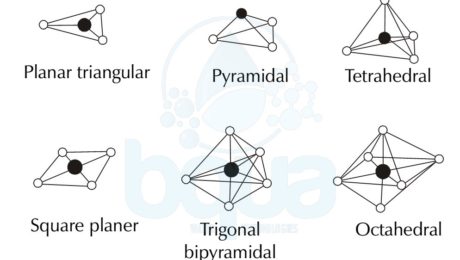
Linear Molecular Geometry
In a Linear Molecular Geometry structure, atoms are bonded together to form a straight line. Bonding angles are of 180° degrees and as an example is the Carbon Dioxide (CO2) and the Nitric Oxide (NO).
-
Planar Triangular –Â Trigonal Planar Molecular Geometry
Trigonal Planar Molecualr Geometry is formed when a compound has an atom at the centre attached to three other atoms in an arrangement that looks like a triangle around the central atom. The four atoms are on the same line and flat on a plane.
-
Trigonal Pyramidal Molecular Geometry
Trigonal Pyramidal Molecular Geometry is obviously shaped like a pyramid with a base that looks like a triangle. The Trigonal Pyramidal structure looks like the Tetrahedral Molecular Geometry, pyramidal structures need three dimensions so that they can fully separate electrons. An example on the Trigonal Pyramidal orientation is Ammonia (NH3).
-
Tetrahedral Molecular Geometry
Tetra means four and tetrahedral means basically a solid or pyramid that has four sides. Tetrahedral Molecular Geometry is formed when one central atom has four bonds with four atoms all at once forming a pyramid-like shape with four sides. As per the VSEPR which is the Valence Shell Electron Pair Repulsion theory, the bond angles between the atoms in the tetrahedral orientation are approximately 109.47°. An example of the Tetrahedral Molecular Geometry is methane (CH4).
-
Square Planar Molecular Geometry
The Square Planar Molecular Geometry is formed when a central atom has four bonds and two lone pairs. Xenon Tetrafluoride (XeF4) is an example of the Square Planar structure, it is made up of six equally spaced orbitals arranged at 90° degrees angles. Which forms an octahedral shape. Two orbitals contain lone pairs of electrons on opposite sides of the central atom. And the other four atoms are bonded to the central atom making the molecule a square planar structure.
-
Trigonal Bipyramidal Molecular Geometry
The Trigonal Bipyramidal Molecular Geometry happens when the central atom is connected to five atoms forming five bonds and no lone pairs. Three out of the five bonds are created along the atom equator forming 120° degrees angles while the remaining two are formed on the atom axis. An example on the Trigonal Bipyramidal Molecular Geometry is the Phosphorus Pentachloride (PCl5).
-
Octahedral Molecular Geometry
Octa means eight and Octahedral Molecular Geometry means a pyramid or solid that has eight sides or faces. Octahedral structure has six bonded atoms forming 90° degrees angles between them. An example on the Octahedral Molecular structure is Sulfur Hexafluoride (SF6).

Molecular Shapes and different types of molecular structures
What is a Covalent Bond
Atoms can bond by sharing electrons in their outermost orbitals and thus giving them the privilege of having a full outermost orbital. For example, the element Hydrogen exists as H2 molecule consisting of two atoms of Hydrogen atom. A covalent bond is simply the force between two atoms resulting from the sharing of electrons in the outermost orbital. Therefore a covalent bond attracts two atoms very close to each others because both atoms share the same electrons in their outermost orbitals.

hydrogen gas formed by covalent bond sharing electron between two hydrogen atoms
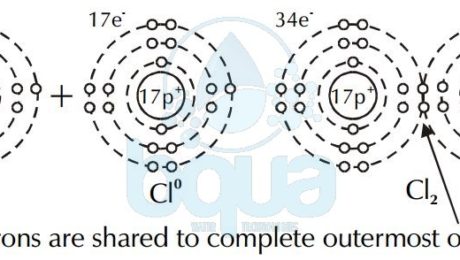
The case of Hydrogen cannot be an ionic bond. That is because Hydrogen ions each have the same charge and therefore are not attracted to one another. This is why a covalent bond happens only when two atoms have a difference in electronegativity of > or = 0.9. Instead, electrons are shared between the atoms to fill the outermost orbital. This type of bond is called a covalent bond. Two atoms of chlorine (Cl0) share a pair of electrons to form chlorine gas (Cl2).

electron shared covalent bond chlorine atom forming chlorine gas
Some molecules formed by covalent bonds may still give up or acquire one or more electrons resulting in a net positive or negative charge. These molecules are called molecular ions.
A covalent bond is very strong. The energy needed to break it is bigger than the thermal energy existing at 25°C which is room temperature. The thermal energy at 25°C is <1 kCal/mole kilo calorie per mole, while to break a typical Carbon covalent bond in an Ethane molecule we need about 83 Kilocalorie per mole.
Properties of molecules defined by covalent bond
While a central atom in a molecule attracts other atoms by covalent bonds, the bonds between these atoms are forming particular angles between them. The force of repulsion among these atoms and particularly the outermost electrons is what shape and determine the angles degrees. The angles and the shape formed is what gives the molecule its properties and shape. An example is the angle formed between Oxygen and Hydrogen atoms in a water molecule, an angle of 105°. You can read about the molecular geometry.
When atoms formed in a covalent bond have the same or very close electronegativity – typically less than 0.9 – the bond (the force of attraction) is equal between electrons since they’re almost identical. This kind of bond is called a non-polar bond. Carbon-Carbon and Carbon-Hydrogen bonds (also called Hydrocarbon) is an example on non-polar bonds.
A polar bond occurs when the difference in electronegativity between two atoms are more than or equal to 0.9. In a polar bond, there’s a partial negative charge (δ−) and a partial positive charge (δ+). This is the case in a water molecule H2O. The bond between Oxygen and Hydrogen is polar since difference in electronegativity is 1.2. (Electronegativity of Oxygen is 3.4 and Electronegativity of Hydrogen is 2.2).
Electron configuration:
The electron configuration is simply the orientation of electrons about the nucleus of the atom. It is known that the atom structure consists electrons, protons and neutrons. An electron has a negative charge, a proton has a positive charge and is in the nucleus with neutrons. Neutrons have neutral charges (non-charged particles).
In a neutral atom, the number of electrons that electron configuration forms are always equal to the number of protons inside the nucleus. The neutron does not contribute to the electrostatic force which is the force that holds the atom together.
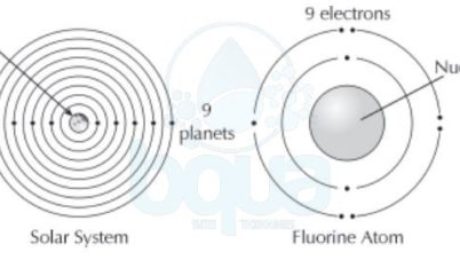
It was found that in the atom structure, electrons tend to orient themselves in a particular fashion. This orientation is called the electron configuration. When atoms get larger and gain more electrons, electrons will exist in particular orbits around the nucleus. A living example of such practice is how each planet in our solar system circles the sun in its own orbit.

electron configuration electrons orient themselves around nucleus protons earth planets
In the electron configuration, we find that more than one electron may exist in the same orbit around the nucleus. The first orbital may contain one to two electrons. While the second orbital may contain up to eight electrons. Each subsequent orbital can hold more and more electrons.
Equation for electron configuration
The equation for the number of electrons in each energy level is:
# of electrons = 2(n)^2 Â where “n” is the nth level
For example: Number of electrons in first energy level = 2(1)^2 = 2(1) = 2 electrons
While number of electrons in the second energy level = 2(2)^2 = 2(4) = 8 electrons and so on.
In the electron configuration, an atom is most stable when its outermost orbital is completely full of electrons. In other words two electrons in the first orbital makes the atom more stable than one. While 8 electrons in the second orbital makes it more stable than < 8 electrons.

atom structure more stable when outermost orbital full of electrons
The orbitals are usually illustrated in two dimensional drawings, in reality the orbitals exist in various three dimensional shapes. Each orbital contains one or more suborbitals identified as s, p, and d. The s, p, and d suborbitals are shaped differently. The shape of the suborbital does not affect the number of electrons in the orbital.

What is Avogadro Number ?
Avogadro Number also known as Avogadro Constant is the number of atoms (6.022 x 10²³) in one gram atomic weight (mole) of an element. Or also Avogadro Number can be defined as the number of molecules in a gram molecular weight (mole) of a compound.
It is sometimes given the symbol of NA or L and the unit of measure is mol-1 as per the International System of Units (SI).

Amadeo Avogadro
Avogadro Biography
Full name: Lorenzo Romano Amedeo Carlo Avogadro di Quaregna e di Cerreto, Count of Quaregna and Cerreto. Italian scientist born on the 9th of August 1776 in Turin, Sardinia. Deceased on the 9th of July 1856.
Avogadro 1837 – 1841 published 4 big volumes discussing in details the physics of matter.
Avogadro’s findings and in particular “Avogadro Number” were completely ignored until Stanislao Cannizarro in 1860 presented them at the Karlsruhe Conference. Which was four years after Avogadro left this world. The reason the conference was held is to clarify the confusion that existed at that time about atoms and molecules and their masses.
Still after that Cannizarro presented his findings, not all scientists were convinced. After a decade – with continued strong advocacy from Cannizarro – Avogardo’s hypothesis became more widely accepted and this is when it was called after Avogadro – Avogadro Number.
Today, Avogadro is considered one of the founders of atomic-molecular chemistry
Avogadro Number was first defined and introduced by Jean Baptiste Perrin as the number of atoms in one gram atomic weight of Hydrogen. Which basically means one gram of hydrogen. Later on, Avogadro Number had been redefined as the number of atoms in 12 grams atomic weight of the isotope Carbon-12 (12C). Furthermore, it also relates the amount of a substance to its molecular weight.
| Table shows the value of Avogadro Number  NA in different units |
|---|
| 6.022(74)x1023Â mol-1 |
| 2.731(12)x1026 (lb-mol)-1 |
| 1.7072(77)x1025 (oz-mol)-1 |
