


Semipermeable Membrane Definition
Semipermeable membrane is a thin, soft, pliable sheet of material that allows certain substances to freely pass through it while restricting the passage of other substances. In the water treatment field, a semipermeable membrane allows water to pass freely while restricts the passing of dissolved materials.
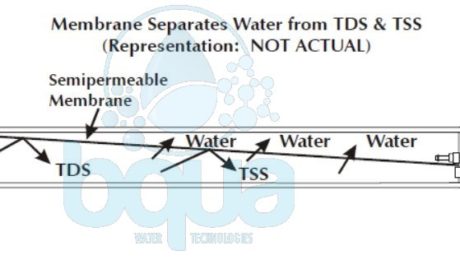
Water passes through a semipermeable membrane into a solution of higher salt concentration. This phenomenon is called Osmosis. The semi-permeable membrane is a material through which water may pass, but prohibits the traveling of nearly everything else. Because of pressurized feed water enters each pressure vessel, a portion of the incoming water goes through the semipermeable membrane. The semi-permeable membrane selectively restricts the passage of suspended and dissolved elements in the raw water.

Semipermeable membrane separating TDS and TSSÂ
The incoming supply water and the dissolved and suspended substances which don’t pass throughout the semipermeable membrane go to waste. One stream enters an RO system and two streams exit. The permeate is the water stream and small amount of TDS which goes through the Semipermeable Reverse Osmosis membrane. While the concentrate is the waste stream containing the water and elements which don’t go through the semipermeable membrane. The concentrate is simply concentrated incoming stream of water. The concentrate contains the TDS and the TSS that are not allowable to pass through the semipermeable membrane.
Read more about the RO Membrane.
معالجة المياه Ù…Øطة توليد الكهرباء Ùˆ الطاقة:
هناك العديد من Ù…Øطات توليد الطاقة ÙÙŠ جميع أنØاء العالم. Ùإنه يأخذ الكثير من مياه التبريد ويأخذ الكثير من المياه عالية النقاء إنشاؤها ÙÙŠ معالجة المياه المتطورة نظام توليد الطاقة لإنتاج الكهرباء. Ù†ØÙ† بØاجة إلى معرÙØ© كي٠يتم إجراء الكهرباء من أجل Ùهم معالجة المياه لخصائص المياه تغذية المرجل وأيضا معالجة مياه مياه تغذية برج التبربد.
لقد رأينا جميعا المØركات الكهربائية، الكهرباء تذهب إلى ل٠المØرك ويسبب تØريك Ø§Ù„Ø±Ù…Ø . توليد الطاقة هو عكس المØرك، إذا تم تشغيل ول٠الرمØØŒ تولد الكهرباء. ÙÙŠ Ù…Øطة توليد الطاقة، ويسمى قسم اللÙات المولد. يتم إرÙاق Ø±Ù…Ø Ø¯Ø§Ø®Ù„ اللÙات إلى Ø±Ù…Ø Ø¯Ø§Ø®Ù„ قسم التوربينات. وداخل التوربينات هي مجموعات من الزعانÙ. يدخل البخار التوربين ويمر عبر الزعان٠مما تسبب ÙÙŠ تØول العمود. وهذا يؤدي إلى إنتاج الكهرباء من المولد.
يجب أن يكون البخار ذات نقاء عالي جدا. إذا كان ÙÙŠ البخار ملوثات مثل السيليكا، Ùإنها يمكن أن يسبب ترسيب على Ø³Ø·Ø Ø±ÙŠØ´ مما تسبب ÙÙŠ خلل من شأنها أن تدمر ÙÙŠ نهاية المطا٠التوربينات. يتم إنتاج البخار عالية النقاء ÙÙŠ المرجل. عندما يتم تسخين المياه السائلة بما Ùيه الكÙاية، يتم إنتاج البخار. المرجل هو وسيلة Ùعالة لغلي الماء وإنتاج البخار. هذا هو السبب ÙÙŠ معالجة مياه المرجل مهم جدا ÙˆØاسمة ÙÙŠ نظام توليد الطاقة.
إن نظام Ù…Øطة معالجة المياه الأكثر استخداما لمعالجة مياه تغذية المرجل هو باستخدام نظام Ø§Ù„ØªÙ†Ø§Ø¶Ø Ø§Ù„Ø¹ÙƒØ³ÙŠ. جنبا إلى جنب مع الراتنج مختلطة، ونØÙ† نضمن إزالة كاملة من أي الملوثات التي يمكن أن تسبب التØجيم داخل التوربينات. زيارة صÙØØ© المنتجات معالجة المياه بكوا لمعرÙØ© المزيد عن نظام Ø§Ù„ØªÙ†Ø§Ø¶Ø Ø§Ù„Ø¹ÙƒØ³ÙŠ وقدراتها.
Water Treatment Power Plant:
There are many power generation plants around the world. It takes a lot of cooling water and it takes a lot of high purity water created in sophisticated water treatment power generation system to produce electricity. We need to know how electricity is made in order to understand the water treatment for boiler feed water properties and also cooling tower feed water.
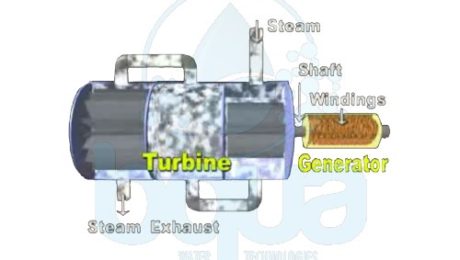
We’ve all seen electric motors, electricity goes into the winding of the motor and causes the shaft to turn. Power generation is the reverse of the motor, if a shaft is turned within the winding, electricity exits the windings.

electricity causes shaft in motor to turn
In a power generation plant, windings section is called the generator. The shaft inside of the windings is attached to a shaft inside of the turbine section. And within the turbine are sets of fins. Steam enters the turbine and passes through the fins causing the shaft to turn. This results in the production of electricity from the generator.

water treatment power plant electricity generation
The steam must be very high purity. If the steam has contaminants like Silica present, they can scale out on the surface of the blades causing an imbalance that will eventually destroy the turbine. The high purity steam is produced in the boiler. When liquid water is heated sufficiently, steam is produced. A boiler is an efficient way of boiling water and producing steam. This is why boiler water treatment along with cooling tower water treatment are very important and critical in the water treatment power generation.
The most commonly used water treatment power plant scheme for treating boiler feed water is by using a reverse osmosis system. Along with a mixed bed resin, we guarantee a complete removal of any contaminants that can cause scaling inside the turbine. Visit BQUA water treatment products page to learn more about our reverse osmosis system and its capabilities.
What is Bioflocculation
Bioflocculation is marked as an advanced, non-chemical, microbial based pre-treatment technology. The technology of bioflocculation uses a novel Rapid Sand Filters RSF configuration together with an extremely porous volcanic Tuff filtration medium. This provides an enlarged surface area for microbial development and biofilm reproduction and propagation.
In the majority of large scale seawater reverse osmosis SWRO plants, the main pre-treatment method is based on granular multimedia filters. This is also known as rapid sand filters (RSF). The vast use of RSF is mainly the result of their simplicity, low energy consumption, and low maintenance and operational costs. Regardless the need to use coagulants such as Alum or ferric sulfate to feed water. RSFs main application is to remove suspended solids greater than 0.35mm in diameter from the feed water stream. It also lowers the level of SDI to around 4. Studies made on RSF also shows that such filters are capable of reducing the levels of suspended particles. Also reducing dissolved TOC, chlorophyll a and transparent exopolymeric particles (TEP). In operation, when a RSF becomes overloaded with particles, a backwash procedure applies. Backwash flushes out the suspended living and non-living particles that has accumulated in the filter bed.
A pilot for Rapid Bioflocculation Filter (RBF) was constructed with two fiberglass columns (each of 6m in height and 1m diameter). It is an upward flowing Bioflocculator (BF) unit, packed with 3m natural porous volcanic Tuff medium (by Tuff Merom Golan). And downward flowing, mixed-media bed filter (MBF) consisting of 80 cm Filtralite (by Filtralite Co.) over 80cm sand. The pilot scale effectiveness is monitored by measuring the efficiency of the removal from the feed water. Key factors were related to membrane clogging; silt density index (SDI), turbidity, chlorophyll a (Chl a) and transparent exopolymer particles (TEP). It is mainly designed to optimize microbiological activity within the filter bed. The results from one year of operation of a large-scale pilot, dual-stage granular filter, indicate that this pretreatment technology with no addition of coagulants. Also no other chemicals gave results equivalent to a conventional RSF with prior chemical (Fe2[SO4]3) treatment.
Bioflocculation Volcanic Tuff Media
Volcanic Tuff grain sizes ranged between 3 and 5 mm in diameter, with a bulk density of 2110 kg/m3 and porosity relative to volume of 26.7%. The total pore area was 20 m2, with extremely wide pore size ranges (0.05 to >10 mm). median pore diameter was 0.75 mm with a characteristic pore length of 62 mm. The large range of pore sizes enabled a wide diversity of microorganisms to colonize the medium pores as a result of reduced shear forces.
Conventional pre-treatment procedures in seawater reverse osmosis SWRO rely mainly on RSF. The process mechanically removes suspended solids greater than 0.35 mm in diameter formed upstream. This occurs after the addition of chemicals in a coagulation and flocculation step. When RSF is overloaded with particles as indicated by high differential pressure across the filter, backwash procedure is carried out. Backwash is mainly flushing and cleaning the filter bed. The same procedure should be taken with RBF filters.
The study made on this new discovery has demonstrated the potential of a biologically-based pre-treatment for SWRO desalination. The results are based on a year-long study. It shows a comparable performance by a large pilot, two-stage, granular Rapid Bioflocculation Filter (RBF) consisting of a Bioflocculator unit with volcanic Tuff medium. This is followed by a Mixed Bed Filter with no prior chemical additives and a standard RSF operating with addition of chemical flocculant [Fe2(SO4)3] upstream. This was at the Hadera SWRO facility in Israel. Much of the effective performance of the RBF is due to the bioflocculation process which occurs within the Tuff medium.
Some biodegradation may also take place. But because of rapid flow rates through RBF, this is unlikely to be a major factor in the filtration process. The study shows that during normal operation there is continuous microbial growth and development of a biofilm layer of organisms. The growth is within an organic matrix that effectively retains different types of colloidal and particulate matter. When shear forces increase during flush cleaning cycles, some of this bio-aggregated material are released into the BF filtrate as bioflocs. These bioflocs are large enough and are mechanically retained with high efficiency by the MBF.
The bioflocculation process that occurs in the first stage of the RBF depends on the metabolism of an extensive, biological food web. It involves different populations of bacteria, archaea, cyanobacteria, protozoa, and even crustaceans and marine worms. It is noteworthy that this kind of microbial environment only develops on the highly porous Tuff grains of the BF and not on the MB filter media.
Conclusion on bioflocculation study
In conclusion, the study demonstrates that with suitable filter bed media and some design modifications, it is possible to construct a rapid granular filter. The RGF achieves effective largescale pre-treatment filtration equivalent to that of currently operating RSF. But without the need for prior chemical coagulation. The research suggest that this approach of using bioflocculation without chemical additives could have considerable potential. It could act as an alternative to conventional RSF pre-treatment for large seawater reverse osmosis SWRO facilities.
