

Boiler Feed Water Properties
Requirements for boiler feed water design and requirements include maximum tolerance levels of alkali, salt, silica, phosphates and other elements. This is in proportion to the pressure at which the boiler will be operated. These boiler water levels must be gotten from the boiler manufacturer, and are basically based on the boiler water properties.

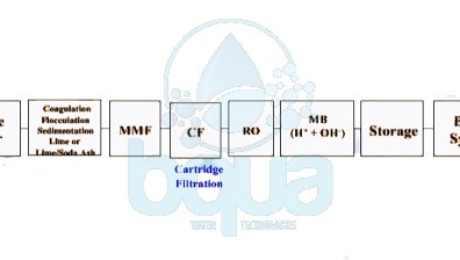
water treatment scheme for boiler feed water
Below tables are the recommended boiler feed water properties / boiler feed water chemical characteristics (levels) Â taken from APAVE. Which is the Association of electrical and steam unit owners), up to pressures of 100 bar for medium steaming rates and for volumes of water in the chambers sufficient to properly control the blow down rates, and from ABMA (American Boiler Manufacturers Association) in its standard guarantee of steam purity.
| Boiler Working Pressure (Bar) | |||||||||
| 0 – 20.7 | 20.8 – 31.0 | 31.1 – 41.4 | 41.5 – 51.7 | 51.8 – 62.1 | 62.2 – 68.9 | 69.0 – 103.4 | 103.5 – 137.9 | ||
| Boiler Feed water | |||||||||
| Dissolved oxygen (measured before oxygen scavenger addition) | 0.04 | 0.04 | 0.0070 | 0.007 | 0.0070 | 0.007 | 0.007 | 0.007 | |
| Total Iron | mg/l | 0.1 | 0.05 | 0.03 | 0.025 | 0.02 | 0.02 | 0.01 | 0.01 |
| Total copper | 0.05 | 0.025 | 0.02 | 0.02 | 0.015 | 0.015 | 0.01 | 0.01 | |
| Total hardness(CaCO3) | 0.3 | 0.3 | 0.20 | 0.2 | 0.1 | 0.05 | not detectable | ||
| Non volatile TOC | 1 | 1.0 | 0.5 | 0.5 | 0.5 | 0.20 | 0.2 | 0.2 | |
| Oily matter | 1.0 | 1 | 0.50 | 0.5 | 0.50 | 0.2 | 0.2 | 0.2 | |
| pHÂ at 25 | 7.5 – 10 | 7.5 – 10 | 7.50 – 10.0 | 7.50 – 10.0 | 7.50 – 10 | 8.5 – 9.5 | 9.0 – 9.6 | 9.0 – 9.6 | |
| Boiler Water | |||||||||
| Silica | mg/l | 150 | 90 | 40 | 30 | 20 | 8 | 2 | 1 |
| Total alkalinity (CaCO3) | 350 | 300 | 250 | 200 | 150 | 100 | not specified | ||
| Free hydroxide alkalinity CaCO3 | not specified | not detectable | |||||||
| Specific conductance at 25 without neutralization | mS/cm | 3500 | 3000 | 2500 | 2000 | 1500 | 1000 | 150 | 100 |
| Boiler Working Pressure (Bar) | ||||||||
| 0 – 15 | 15 – 25 | 25 – 35 | 35 – 45 | 40 – 60 | 60 – 75 | 75 – 100 | ||
| Boiler Feed water | ||||||||
| Dissolved oxygen (measured before oxygen scavenger addition) | mg/l | 0.02 (Physical removal of dissolved oxygen) | ||||||
| Total hardness | French degrees | 0.5 | 0.3 | 0.2 | 0.1 | 0.05 | 0.05 | 0.05 |
| Oily matter | mg/l | absence | 0.05 | 0.05 | 0.05 | |||
| pH | > 8.5 | |||||||
| Total Iron | mg/l | not specified | 0.05 | 0.05 | 0.03 | |||
| Total copper | not specified | 0.03 | 0.03 | 0.01 | ||||
| Boiler water | ||||||||
| MÂ alkalinity | French degrees | 100 | 80 | 60 | 40 | 15 | 10 | 5 |
| P alkalinity | 0.07 M | 0.070 M | 0.07 M | 0.070 M | > 0.5 M | > 0.5 M | > 0.5 M | |
| SiO2 | mg/l | 200 | 150 | 90 | 40 | 15 | 10 | 5 |
| TDS | 4000 | 3000 | 2000 | 1500 | 500 | 300 | 100 | |
| Phosphates | 30 to 100 | 31 to 100 | 20 to 80 | 21 to 80 | 10 to 60 | 10 to 40 | 5 to 20 | |
| pH | 10.5 to 12 | 10 to 11 | ||||||
| Make up water | Softened or softened and carbonate free | Demineralized | ||||||
What is a Crystal Lattice ?
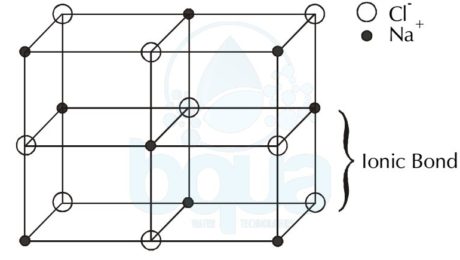
Crystal Lattice is the solid formed by the force of attractions between the charged ions; anions and the cations. It is basically the three dimensional pattern or arrangement of  the atoms inside the crystal.
Since cations are positively charged ions and anions are negatively charged ions, they are strongly attracted to each other. This attraction is very strong that the ions may bond together into a solid called a crystal lattice. The bond that holds the two oppositely-charged ions is called an ionic bond.
Types of Crystal Lattice Structures:
Crystal Lattice exist in seven crystal lattice structures which are:Â
- Cubic
- Monoclinic
- Triclinic
- Hexagonal
- Tetragonal
- Orthorhombic
- Rhombohedral
Each of these crystal lattice structures have unique variants which make the total number of crystal lattice structures 14 Bravais Lattices. The cubic crystal lattice structure has a symmetrical shape and is considered the simplest and most symmetrical form of crystal lattices.
The 3 types of cubic crystal lattice structures are:Â
- Simple Cubic (SC)
- Body-Centered Cubic (CBC)
- Face Centered Cubic (FCC).
Sodium Chloride Crystal Lattice:
An example is the Sodium Chloride – salt – molecule NaCl, since the Sodium (Na) became a cation when it lost an electron to give it to the Chloride atom (Cl) which hence became a negatively charged anion. The ionic bond is the force that is keeping the anions and cations in the solid shape of crystal lattice form.

crystal lattice formed by force of attraction between anions and cations ionic bond
You can also read about Molecular Geometry.
What is Periodic Table of Elements:
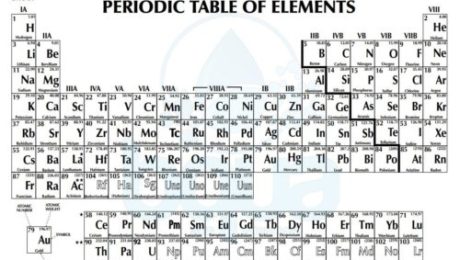
Atoms of different elements are distinguished only by the number of subatomic particles; electrons, protons and neutrons. Scientists decided to organize the elements in a periodic table based on the number of these particles in the atoms of each element. By the time, a chart was developed which described the atom structure of each element. This chart has come to be known as the periodic table of elements.

periodic table of elements including atomic number atomic weight
By observing the periodic table there are a lot of important information for each element. We see that each element in the periodic table has a Chemical Symbol which is usually the first one or two letters of the element’s name. For instance: H for Hydrogen, He for Helium, O for Oxygen, Ca for calcium, etc. In other cases, there are elements that have symbols which do not correspond to the name of the element. For instance: Na for sodium, K for potassium, etc. These letters are abbreviations of the Latin name of these elements. Na are the first two letters of Natrium (Sodium in Latin), K is the first letter of Kalium (Potassium in Latin) and so on.
Another observation in the periodic table is that each element has a corresponding number. This number is called the atomic number and it refers to the number of protons in the nucleus. Since we know that in neutral atoms (not charged) the number of protons is equal to the number of electrons, the atomic number also equals the number of electrons.

atomic number and atomic weight in periodic table of elements
The number which is greater than the atomic number is called the atomic weight. The atomic weight also called gram atomic weight is the weight of a particular number of atoms of the element in grams.
Boiler Water Treatment
Boiler water treatment is one type of industrial water treatment which is focused on removing both organic and inorganic elements that can cause damages to the boiler. Water treatment takes places to avoid scaling, corrosion, or foaming. Raw or feed boiler water is treated before the contaminants/impurities reach the boiler. Internal boiler water treatment’s purpose is to prevent dissolving of the boiler and to keep contaminants in certain formations and levels that do not harm it or cause a blow down.
Water can be easily and quickly heated when exposed to a temperature rise than any other inorganic matter. When it evaporates and turns into steam at atmospheric pressure it dilates by one thousand and six hundred times. While in form of steam, it is charged with a huge amount of heat, and with these special characteristics water has it makes a special element for boilers, heaters and power generators.
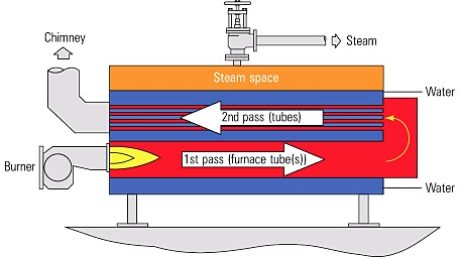
There are basically many types of boilers, among them are only two types of boilers that are mostly and widely used today. There is the fire tube boiler and the water tube boiler. Both have different yet opposite mechanism of operation. The fire tube boiler has its heat source located inside a furnace or a fire box that is surrounded by water. This is in order to maintain the temperature of the heating surface below the boiling point.
As in case water tube boilers, it is completely the opposite. Water and steam flow inside the tubes and the hot gases flow over the outside surface. The circulation system in the water tube boiler is constructed of tubes, headers, and drums joined in arrangement that provide water flow to generate steam.
Boiler Make up Water
Water contains both suspended and dissolved solids and gases in assorted quantities. Varying from 30 grams/liter for seawater and ranging from 0.005 to 1500 milligrams/liter for fresh water. These water contaminants cause erosion and corrosion for boilers and yet other issues. This is when water treatment is considered for boiler make up water in order to bring out a certain standard and quality. Purpose is to make boiler water safe to be used in generation of steam in steam generators and boilers.
Every boiler has a design that requires a certain level of impurities. And this level cannot be exceeded in the water being used. It is more like a tolerance that is limited and if exceeded it can cause serious deterioration of the boiler. This is why boiler water with high amounts of impurities has to be pretreated and contaminants has to completely removed before being transformed into steam to improve quality.
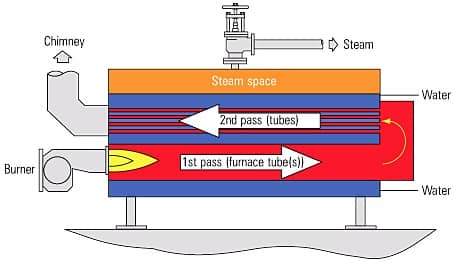
Mechanism of a fire tube boiler
Both quantity of nature of impurities in the boiler water are considerable. For instance hardness, iron and silica are of high concern than sodium salt. Flow rate and design of the boiler are highly considered factors in treatment of feed boiler water. Also of these factors; pressure, heat transfer rate, etc. A low pressure fire tube boiler can tolerate high level of hardness with the use of a certain treatment. Contaminants must be completely be removed in case of modern boilers that use high pressure.
BQUA is proudly capable of supplying you with the necessary and suitable equipment in order to treat your boiler feed water prior to entering the equipment. This to make sure no scaling or fouling would occur inside of the boiler and guarantee a long service life without any problems. Please contact our technical sales engineers for more information.
Read more about the boiler water characteristics and feed make-up water properties
