


What is Vapor Compression VC
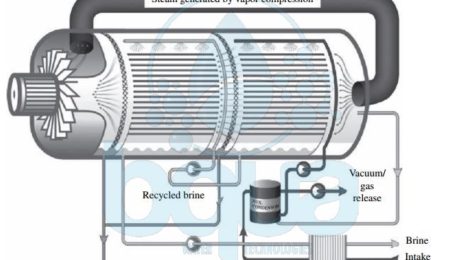
Vapor Compression VC is one type of thermal desalination technologies which also include Muti Stage Flash Distillation MSF and Multi Effect Distillation MED. In Vapor Compression VC, the heat source for vapor compression (VC) systems is compressed vapor produced by a mechanical compressor or a steam jet ejector rather than a direct exchange of heat from steam . In Vapor Compression VC systems the source water is evaporated and the vapor is conveyed to a compressor. The vapor is then compressed to increase its temperature to a point adequate to evaporate the source water sprayed over tube bundles through which the vapor is conveyed. As the compressed vapor exchanges its heat with the new source water being sprayed on the evaporation tubes, it is condensed into pure water. A feed water preheater (plate-type heat exchange) is used to start the process and reach evaporation temperature. Vapor Compression VC and Multi Effect Distillation MED work based on similar principles.

vapor compression tehnology thermal desalination process system
However, in Multi Effect Distillation MED steam produced by source water evaporation is introduced and condensed in a separate condenser. Condenser is located in the downstream effect. In Vapor Compression VC, the steam generated from evaporation of new source water sprayed on the outside surface of the heat exchange tubes is recirculated by the vapor compressor. It is then introduced into the inner side of the of the same heat exchange tubes in which it condenses to form distillate. Vapor Compression VC desalination has found applications mostly in small municipal and resort water supply systems. As well as industrial applications. The total amount of power required for the operation of mechanical Vapor Compression VC systems is typically 8 to 12 kWh/m3 (30 to 45 kWh/1000 gal) of product water.
Reference: “Desalination Engineering” by Nikolay Voutchkov
What is an Atom Definition
An atom is the most discrete indivisible particle that forms an element. Atoms of the same element are identical; different elements have non-similar atoms. The most simple of all elements is Hydrogen.Â
Example: Hydrogen atoms are similar while Oxygen atoms are different than Hydrogen atoms. Two hydrogen atoms and one Oxygen combined form the water molecule H2O.
The atoms are extremely small. Therefore, even the most powerful microscopes cannot see them. Actually, 6.022X10^23 hydrogen atoms (Avogadro Number) weigh only one gram. There are 454 grams in one pound.
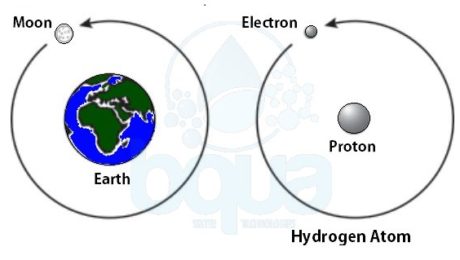
In order to understand the nature of the atom, we should identify the forces that are holding it together. Much as our plant, gravity is the force holding the moon in its orbit around the earth. Gravity is the force of attraction between two large masses.
In the case of the atom, the small size of the particles and the speed at which the electron travels would prohibit a force such as gravity from being able to hold the atom together. Scientists have learned that electrostatic force is the force that maintains the atom.
Atoms Composition
While atoms are composed of small subatomic particles; these particles are the electron, the proton and the neutron. The proton and neutron are found in the nucleus which is the center of the atom. The electron is negatively charged and orbits around the nucleus.

atom composed of subatomic particles electron proton neutron
Atoms from different elements are constituted of the same type of subatomic particles. However, the proportions of the subatomic particles are different for each element. Hydrogen for example has two subatomic particles; an electron and a proton. In the case of hydrogen, a single electron orbits a single proton. ÙAn example is the moon which orbits the earth. Same as in the case of earth, the proton of the hydrogen atom is much larger than the electron.

an electron orbits proton in nucleus in an atom like moon orbits earth
Moreover, if we add a subatomic particle to a Hydrogen atom, we create another atom of another element. Note: The number of subatomic particles is what characterizes atoms of different elements. In addition, if we want to create a Helium atom, we should only add an additional electron, an additional proton and two neutrons to the Hydrogen atom. As a result, we’ll have two electrons orbiting four other particles, two protons and two neutrons in the nucleus.
What is Osmosis Definition
Osmosis is a natural process (phenomenon) that occurs in nature around us. The Osmosis process is even happening now within our bodies while reading this post.
A simple definition of Osmosis is that it is the tendency of a fluid to pass or flow through a semipermeable membrane into solution of higher concentration. Osmosis is the process whereby the water that we drink eventually ends up in our blood, muscles, and cells. The lining in our intestine is a membrane. The yolk of an egg has a membrane surrounding it that releases its contents when broken. If we simply wrap a piece of meat with plastic wrap, we can consider the plastic wrap a membrane.
A definition of permeable is when materials can pass through it. For example, a kitchen strainer or sieve is totally permeable to water. Meaning that water passes freely through it. Semipermeable means that some materials pass while others don’t. The kitchen strainer is an example. Since it allows water to pass freely through it but will not allow large solids to infiltrate.
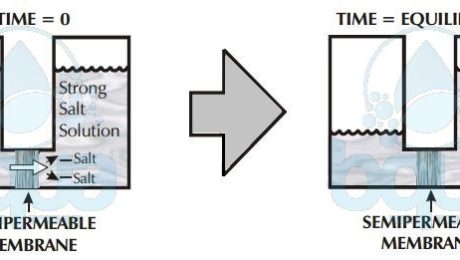
Back to Osmosis, water passes through semi-membrane from low salt concentration into a solution of high concentration. The reason is simple, let’s imagine having a salt solution and pure water separated by such a membrane. We know that water molecules may freely pass through the membrane but dissolved substances can’t. Given that all molecules are in motion, which liquid will have the greatest number of molecules colliding with the membrane? The pure water or the salt water?
Per given area of membrane, the pure clean water side will have more molecules of water that collide with the membrane than the side of water with salt. Water in Osmosis, therefore will pass from the side with pure or clean water to the salt water side. The higher the concentration of salt, the fewer the collisions of water molecules with the membrane. In Osmosis, water always passes through a semi-permeable membrane, therefore, from a lower salt concentrated side into a higher concentrated side.

osmosis: lower salt concentration to higher concentration
Osmosis then describes the tendency of fluid (water) to pass through a semi-permeable membrane, into a solution of higher concentration. The process stops when the number of water molecules colliding with either side of the membrane are equal. The number of collisions is a function of the salt concentration and the pressure on whichever membrane side. These are called osmotic pressure and applied pressure.
Osmosis reaches equilibrium when the concentration of dissolved solids at both compartments is equal. Meaning no more net flow from one side to another. The side that was the higher concentration solution however now has a higher water level than the other side due to osmosis. This difference in height between both sides is due to osmotic pressure.
Now that you learned about Osmosis, you might want to read about Reverse Osmosis (RO).
Radium Removal
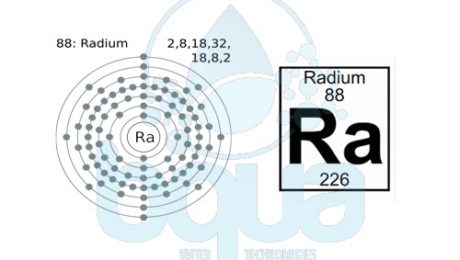
Radium 226 and radium 228 are natural groundwater contaminants that usually occur at trace levels. For any water treatment application, radium removal is substancial since its presence cause serious health problems and even death at some point. Radium A strong acid cation exchange resin operated in the sodium cycle is a very effective method of radium removal.
Radium is like barium, it has a higher selectivity for cation exchange resins than hardness. It will also be removed during the normal water softening cycle. In a manner similar to barium, on the first cycle of exhaustion, radium will continue to load on the resin bed until well after hardness breakthrough by displacing all the other ions previously loaded, including calcium and magnesium. This effect is valid only for the first cycle and can be misleading.

Radium removal water treatment radium 226 radium 228
Point-of-use cartridges, which use ordinary softener resins on a one-time basis for radium removal. Will provide decent radium removal for over 5 to 15 times. This depends on the particular resin as long as they will produce softened water. In systems that can be regenerated, however, radium like barium. This means it is much harder to regenerate off the resin and more of it will remain in the resin after regeneration. The radium will be pushed toward the exit (bottom) of the resin bed during the regeneration cycle. As the softener becomes exhausted, hardness leakage reaches the radium-rich end of the resin bed.
The hardness, which is less preferred by the resin, will displace only a small, but nevertheless, significant amount of radium from the resin, causing radium levels to increase to unacceptable levels. Therefore, in systems that are regenerated it is necessary to limit the service cycle to the softener capacity for hardness. Since the amount of radium is insignificant compared to hardness, the softener design calculations are made for an ordinary softener.
Learn more about BQUA’s water treatment products
