


What is a Cellulose Acetate Membrane
The thin semi-permeable film of the first Reverse Osmosis membranes was developed in the late 1950s at UCLA (University of California Los Angeles). It was made of cellulose acetate (CA) polymer. A Cellulose Acetate membrane have a three-layer structure similar to that of a Polyamide Thin Film Composite TFC membrane. The main structural difference is that the top two layers (the ultrathin film and the microporous polymeric support) are made of different forms of the same Cellulose Actetate polymer.
Cellulose is a polymer that is made up of repeating units (monomers) of C6H10O5. (Note: A monomer is a molecule which comes together with other identical monomers to form a chain of monomers, called a polymer). The number of acetates on the cellulose molecules affects the semi-permeability and other characteristics of the membrane. In general, the following are some of the most important differences between diacetate and triacetate membranes.

cellulose polymer cellulose acetate membrane
In a TFC membrane these two layers are made of completely different polymers. The thin semi-permeable film is polyamide, while the microporous support is polysulfone. Similar to a TFC membrane, a Cellulose Acetate membrane have a film layer that is typically about 0.2 um thick. But the thickness of the entire membrane (about 100 um) is less than that of a TFC membrane (about 160 um). One important benefit of a Cellulose Acetate membrane is that the surface has very little charge and is practically uncharged. As compared to a TFC membrane, which have a negative charge and can be more easily fouled with cationic polymers. If such polymers are used for source water pre-treatment.

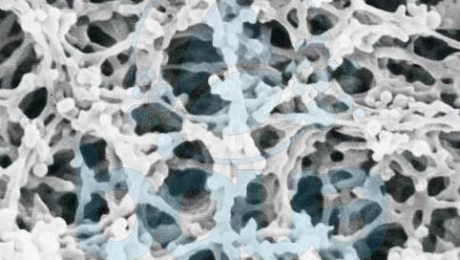
cellulose acetate membrane pores under microscope
In addition, a Cellulose Acetate membrane have a smoother surface than a TFC membrane. Which also renders them less susceptible to fouling. Cellulose Acetate membrane have a number of limitations. Including the ability to perform only within a narrow pH range of 4 to 6 and at temperatures below 35 C (95 F). Operation outside of this pH range results in accelerated membrane hydrolysis, while exposure to temperatures above 40 C (104 F) causes membrane compaction and failure. In order to maintain the Reverse Osmosis concentrate pH below 6, the pH of the feed water to the cellulose acetate membrane are reduced to between 5 and 5.5. This results in significant use of acid for normal plant operation and requires Reverse Osmosis permeate adjustment by addition of a base (typically sodium hydroxide) to achieve adequate boron rejection.
Cellulose Acetate membrane experience accelerated deterioration in the presence of microorganisms. Since they’re capable of producing cellulose enzymes and bioassimilating the membrane material. However, they can tolerate exposure to free chlorine concentration of up to 1.0 mg/L. Which helps to decrease the rate of membrane integrity loss due to destruction by microbial activity.
Since Cellulose Acetate membrane have a higher density than a Polyamide TFC membrane. They create a higher headloss when the water flows through the membranes. Therefore a cellulose acetate membrane operates at higher feed pressures, which results in elevated energy expenditures. Despite their disadvantages, cellulose acetate membrane have high tolerance to oxidants (chlorine, peroxide, etc.). As compared to a PA TFC membrane. Cellulose Acetate membrane are used in municipal applications for saline waters with very high fouling potential. Mainly used in the Middle East and Japan in seawater reverse osmosis plants, and for ultrapure water production in pharmaceutical and semiconductor industries.
Chemical Reaction Definition
A Chemical Reaction is the change that occur to a chemical compound or molecule to form another. This usually leads to a change in the arrangement of electrons and breaking of bonds between atoms or molecules. In addition, chemical reaction produces no change to the cores of the atoms involved. New formed substances have different characteristics and properties.
We know how atoms bond together to form molecules, but you may ask why do certain molecules form. Certain elements combine to form compounds or why do certain compounds react with one another to form new compounds.
Chemical Reaction Examples
For example, when we mix calcium carbonate and hydrochloric acid, we get a violent chemical reaction which releases a large amount of gas.
CaCO3 + 2HCl ——> CaCl2 + H2O + CO2
Calcium Carbonate + Hydrochloric Acid -> Calcium Chloride + Water + Carbon Dioxide
In fact, this equation presents a chemical reaction. In this chemical reaction calcium carbonate reacts with hydrochloric acid to form calcium chloride, water and carbon dioxide. Consequently, this along with many other chemical reactions, are considered a spontaneous chemical reaction. Hence, it will begin and continue to completion on its own.
Types of Chemical Reactions
Spontaneous Reactions
2Na + 2H2O ——> 2NaOH + H2
Metallic Sodium + Water -> Sodium Hydroxide + Hydrogen Gas
NaHSO3 + HOCl ——> NaCl + H2SO4
Sodium Bisulfite + Hypochlorous Acid -> Sodium Chloride + Sulfuric Acid
Other chemical reactions are not spontaneous, however, will still continue on its own once started with a type of energy input.
Chemical Reaction Requiring An Initial Energy Input
2H2 + O2 —Energy—>Â 2H2O
Hydrogen Gas + Oxygen Gas -Energy-> Water
CH4Â + 2O2 —Energy—>Â CO2 + 2H2O
Methane + Oxygen -Energy-> Carbon Dioxide + Water
Much as a spontaneous chemical reaction, another type of chemical reaction requiring a continuous energy input.
Chemical Reaction Requiring AÂ Continuous Energy Input
N2 + 3H2 —Cont. Energy—>Â 2NH3
Nitrogen Gas + Hydrogen Gas -Cont. Energy-> Ammonia
CaCO3 —Cont. Energy—>Â CaO + CO2
Calcium Carbonate -Cont. Energy-> Calcium Oxide + Carbon Dioxide
In addition, can actually explain the chemical reaction types using the example of a ball rolling down stairs. In the case of the spontaneous chemical reaction, we can see the ball rolling down a set of stairs where each step is slightly sloped downhill. What happens is that the ball continues to roll down from step to step with no assistance.

spontaneous chemical reaction example ball rolling down set of inclined stairs
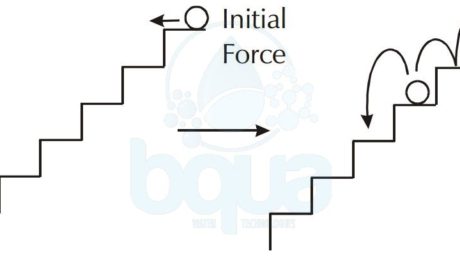
As in the case of a reaction requiring an initial energy input, we can use a ball rolling down a set of stairs where each step is a level. The ball continues to roll from step to step by an initial input trigger which is a push.

chemical reaction initial energy input example ball rolling down stairs
In the last example, a chemical reaction requiring continuous energy input, we can imagine a ball starting from the bottom of the stairs. In order to get the ball to the top, we have to continually add energy to the reaction.

chemical reaction continuous energy input example ball from bottom to top of stairs
As in the case with the ball and stairs, a spontaneous chemical reaction will proceed in the direction
which produces products having the lowest potential energy level. Furthermore, the chemical reactions which require only an initial energy boost have an energy “hump†which must be overcome before the reaction will proceed on its own.
Finally, the non-spontaneous chemical reaction produces products having a higher potential energy level. Therefore, these reactions require a continuous energy input (rolling the ball uphill). The change in energy between the reactants and products of a reaction is referred to as the change in enthalpy.
What is a Hydrogen Bond
A water molecule will form a bond called a hydrogen bond. A hydrogen bond is formed because of the polarity of the molecule and the fact that hydrogen atoms are present in the molecule. water molecules will form hydrogen bond with another molecule(s) of water. These bonds are not nearly as strong as the covalent bond between the hydrogen atoms and the oxygen atom within one H2O molecule.
We can simply say that a Hydrogen Bond is a weak bond that occurs between a proton of a molecule and an electronegative atom of another molecule as a result of an electrostatic attraction between the two molecules. The Hydrogen bond can either happen between two different molecules or within the same molecule.
Hydrogen bond gives water many of its amazing properties, including:
– High Boiling Point
–Â Surface Tension
– Capillary Action
– Solvent Ability
The molecular weight of water is 18; which is the sum of the atomic weights of the atoms in one molecule. Most compounds of such a small molecular weight (MW) are gases at room temperature and pressure.
Considering the example of nitrogen (N2) as compared to water. Nitrogen has a MW of 28 and a boiling point of 321°F (-196°C) below zero. Water, on the other hand, has a MW of 18 and a boiling point of 212°F (100°C), a difference of 533°F (296°C).

hydrogen bond water and nitrogen difference properties
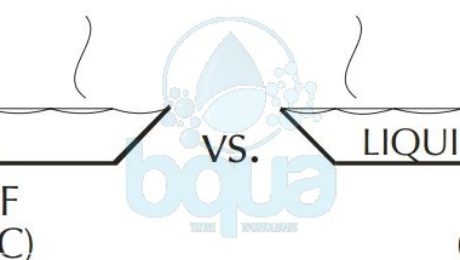
The difference between nitrogen and water is that the nitrogen molecule has no force of attraction between molecules. Water, of course, has the hydrogen bond between molecules. Although the hydrogen bonds are weak compared to other bonds, they are significant enough to create the tremendous difference in boiling points between the two compounds. The picture below shows few molecules of water and molecules of nitrogen within a pure liquid state.

hydrogen bonding water nitrogen difference in properties
What is Polarity Definition
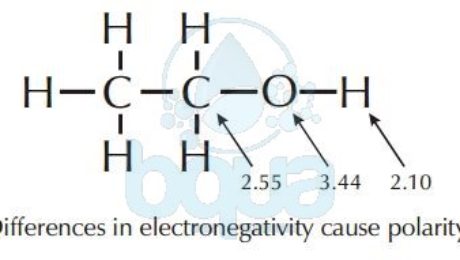
Polarity is basically the difference in electronegativity between two molecules; which is simply the affinity of an atom to electrons. Atoms of the same molecule have influence on each other in many ways. One of the reasons is electronegativity. An example is a water molecule, because of the electronegativity difference between the Oxygen atom (3.4) and Hydrogen atom (2.2) it has areas of partial negative and positive charges. Meaning that one side of the bond possesses a partial negative charge, while the other side has a partial positive charge. This is referred to as polarity, and the water molecule is said to be polar. This polarity is due to the electronegativity of the atom-of-oxygen.
The example of the Oxygen – atom in the water – molecule explains polarity. Oxygen atoms attracts electrons more than the Hydrogen atoms. This results that the pair of electrons shared spend more time around the oxygen nucleus than around the hydrogen nucleus. When a shared electrons’ pair is orbiting the oxygen nucleus, the proton of the hydrogen nucleus is exposed and the oxygen/atom has more electrons than protons. This creates the partial -ve and partial +ve charges making the molecule of water acquire polarity characteristics.

Electronegativity of oxygen cause polarity in water-molecule
The relative electronegativities of the atoms involved is what determines the polarity of bonds determined. These electronegativity values are also determined from a variation of the periodic table of the elements called the periodic table of elements.
Most hydrocarbons (molecules made up of both Carbon and Hydrogen atoms) are extremely nonpolar because of the similarity in the electronegativity of Carbon – Hydrogen. In other words, the hydrogen and carbon atoms share electrons fairly equally.

Polarity caused by electronegativity difference between two atoms in moleculeÂ
Polarity and properties of molecules
Nonpolar molecules do not have significant partial charges, therefore they will not attract polar molecules. Opposite charges attract, similar charges repel one another, but there is no attraction or repulsion between nonpolar molecules. For example, we know that gasoline (a hydrocarbon) will not mix with water. However, if we add oxygen to the hydrocarbon molecules we see that the molecules become polar. Ethanol (drinking alcohol), for instance, completely mixes with water.
Soaps and detergents are unique molecular combinations of polar and nonpolar compounds. Nonpolar part of molecule will react with oils found on soiled hands or clothing while polar part reacts with water. The result is oils removal (nonpolar) from water (high polarity). The polar end of soap is a functional group.

soap made of hydrocarbons and polar end functional group
The incompatibility between nonpolar compounds and water is due to the attraction that water molecules exhibit for one another. Positive charge on the hydrogen of a water-molecule will attract negative charge of atom of oxygen in adjacent water molecule. This attraction, called a hydrogen bond, will cause a type of bond between the molecules themselves.
Because of lack of charges, nonpolar compound won’t have the strength to break the hydrogen bonds between the water molecules. Therefore the nonpolar compound won’t combine with water.
