

 ما هو تعري٠الموصلية الكهربائية
الموصلية الكهربائية هي قياس الأيونات الذائبة. يقيس الموصلية الكهربائية بشكل غير مباشر الأيونات عن طريق قياس مرور الالكترونات من خلال عينة من الماء. الØلول التي تØتوي على الكثير من الأيونات المنØÙ„ ستكون لديها موصلية كهربائية عالية. الØلول التي لديها تركيز منخÙض من الأيونات المذابة سو٠يكون لها موصلية منخÙضة.
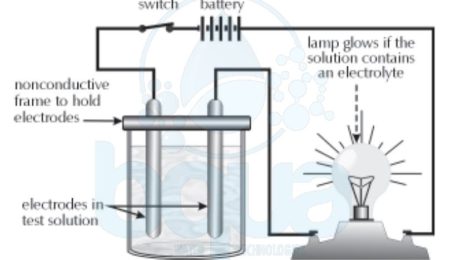
السلوك ÙÙŠ الØÙ„ ينطوي ÙÙŠ الواقع على Øركة الأيونات. تظهر الصورة جهازًا يمكن استخدامه لإظهار أن Øلول الأيونات الذائبة (Ø§Ù„Ø£Ù…Ù„Ø§Ø Ø§Ù„Ø°Ø§Ø¦Ø¨Ø©) ÙÙŠ الماء ستجتذب الطاقة الكهربية للبطارية من خلالها ÙˆØªØ³Ù…Ø Ù„Ù…ØµØ¨Ø§Ø Ø§Ù„Ø¶ÙˆØ¡ بالضوء. تعري٠الالكتروليتات هو مجرد الØÙ„ الذي سيجري التيار.
تسمى الأيونات المشØونة إيجابيا “الكاتيونات” ØŒ وتسمى الأيونات السالبة الشØنة “الأنيونات”. وتتشكل الكاتيونات عندما يتم Ùقد واØد أو أكثر من الإلكترونات من ذرة أو مجموعة من الذرات ØŒ يتم تشكيل الأنيونات عند اكتساب واØد (1) أو أكثر من الإلكترونات بواسطة ذرة أو مجموعة ذرات. ÙŠØتوي المنØÙ„ بالكهرباء على الكاتيونات والأنيونات. كلما زاد عدد الكاتيونات والأنيونات الموجودة ØŒ كلما ارتÙعت الموصلية الكهربائية. إذا تم قياس كمية التيار المارة عبر المØلول بمقياس الموصلية ØŒ يمكننا أن Ù†Øدد عدد الأيونات التي تذاب ÙÙŠ المØلول. عندما يمر التيار أكثر من خلال الØÙ„ ØŒ Ùإننا نعر٠المزيد من الأيونات الموجودة.
تقلل الموصلية الكهربائية ÙÙŠ المØلول مع انخÙاض درجة الØرارة ØŒ ÙÙŠ Øين أن توصيل موصل كهربائي صلب (مثل الأسلاك النØاسية) يزيد مع انخÙاض درجة الØرارة. وبالتالي ØŒ يبدو أن المواصلة ÙÙŠ الØÙ„ مختلÙØ© عما هي عليه ÙÙŠ Øالة صلبة ØŒ وهي كذلك. ÙŠØدث التوصيل ÙÙŠ المØلول نتيجة للأيونات الموجبة والسالبة التي تنتقل عبر المØلول. هذا Ù…ÙˆØ¶Ø ÙÙŠ الصورة. Ù…Ù„Ø Ø§Ù„Ø·Ø¹Ø§Ù… ØŒ كلوريد الصوديوم (NaCl) ØŒ تم إذابته ÙÙŠ الماء لإنشاء إلكتروليت ØŒ وتم تركيب مقياس قياس لقياس التيار.
قياس الموصلية الكهربائية باستخدام مقياس التيار الكهربائي
ÙÙŠ الإلكتروليت الموضØØŒ يتم تمرير الإمكانات الكهربائية Ùعليًا عبر السائل بواسطة Øركة الكاتيونات والأنيونات. تنجذب الكاتيونات (أيونات الصوديوم) إلى القطب السالب وتهاجر إليها. تنجذب الأنيونات (أيونات الكلوريد) إلى القطب الموجب ثم تهاجر إليها. بمجرد وصول أيون الكلوريد السالب إلى القطب الموجب ØŒ Ùإنه يتبرع بإلكترون ØŒ وبمجرد وصول أيون الصوديوم الإيجابي إلى القطب السالب ØŒ Ùإنه يكسب الإلكترون. يمر الكهربائيةالإلكترون المØول (كلوريد إلى صوديوم) عبر مقياس التيار الكهربائي ويسجل كتيار (موصلية كهربائية).
من المهم ملاØظة أن الموصلية الكهربائية لا تخبرنا بنوع الأيونات الموجودة. التوصيلية هي Ùقط قياس نسبي للعدد الكلي للأيونات الموجودة. أيضا ØŒ بعض الأيونات تبدي موصلية كهربائية أعلى من غيرها لأنها أكثر Øركة. أيونات الهيدروجين هي أكثر الأيونات موصلة. أيونات الهيدروكسيد هي الأكثر موصلة بعد ذلك. جميع الأيونات الأخرى تقع تØت هاتين الأمرين بقدر ما نشعر بالقلق الموصلية.
على سبيل المثال ØŒ قد يعطي Ù…Øلول كبريتات الكالسيوم Ù†Ùس الموصلية الكهربائية كمØلول من كلوريد الصوديوم على الرغم من أن Ù…Øلول كبريتات الكالسيوم قد ÙŠØتوي على أيونات أكثر إجماليًا من Ù…Øلول كلوريد الصوديوم. هذا لأن الصوديوم والكلوريد هما أيونات أصغر وينتقلان عبر المØلول بسرعة أكبر.
كما ستعرض المياه النقية بعض الموصلية الكهربائية، على الرغم من قلة توصيلها. ويرجع ذلك إلى Øقيقة أن الماء سو٠يؤين كل من أيون الهيدروجين وأيونات الهيدروكسيد (OH) بشكل Ø·Ùي٠جدا. أذكر أن الماء يتأين إلى Øد 1 × 10⁻⁷ مول لكل لتر ØŒ وينتج 1×10⁻⁷ مول/ لتر من أيونات الهيدروجين ونÙس العدد من مول/لتر من أيونات الهيدروكسيد.
H2O ——-> [H +] + [OH-]
What is Conductivity Definition
Water conductivity is a measurement of dissolved ions. Water conductivity indirectly measures ions by measuring the passage of electrons through a sample of water. Solutions which have a lot of dissolved ions will have a high conductivity. Solutions which have a low concentration of dissolved ions will have a low conductivity.

Water Conductivity: Pure Water vs Seawater
Conductance in a solution actually involves the movement of ions. Picture shows an apparatus which can be used to show that solutions of dissolved ions (dissolved salts) in water will pass the electric potential of a battery through them and allow the light bulb to light. Electrolyte definition is simply a solution which will conduct a current.

Water Conductivity Measurement Using Apparatus
Positively-charged ions are called “cationsâ€, negatively-charged ions are called “anions.†Cations are formed when one or more electrons are lost from an atom or a group of atoms, anions are formed when one or more electrons are gained by an atom or group of atoms. An electrolyte contains cations and anions. The more cations & anions present, the higher the conductivity. If the amount of current passing through a solution is measured with a conductivity meter, we can tell relatively how many ions are dissolved in the solution. When more current passes through the solution, we know more ions are present.
Water Conductivity decreases as temperature decreases, whereas the conductance of a solid conductor (such as a copper wire) increases with decreasing temperature. Water Conductance in would therefore appear to be different than in a solid, and it is. Water Conductivity actually occurs as a result of positive and negative ions moving through the solution. This is illustrated in the picture. Table salt, sodium chloride (NaCl), has been dissolved in water to create an electrolyte, and an ammeter has been installed to measure current.

Water Conductivity Measurement Using Salt Ammeter
In the electrolyte shown above, the electric potential is actually being passed through the liquid by the movement of cations and anions. The cations (sodium ions) are attracted to the negative electrode and migrate to it. The anions (chloride ions) are attracted to the positive electrode then migrate to it. Once a negative chloride ion reaches the positive pole, it donates an electron, and once a positive sodium ion reaches the negative pole it gains an electron. The transferred electron (chloride to sodium) passes through the ammeter and registers as current (conductivity).
It is important to note that water conductivity does not tell us what type of ions are present. Conductivity is only a relative measurement of the total number of ions present. Also, some ions exhibit a higher conductivity than others because they are more mobile. Hydrogen ions are the most conductive ions. Hydroxide ions are the next most conductive. All other ions fall below these two as far as conductivity is concerned.
For example, a solution of calcium sulfate may give the same conductivity as a solution of NaCl although the calcium sulfate solution may have more total ions than the sodium chloride solution. This is because sodium and chloride are smaller ions and travel through the solution much more rapidly.
Pure water will also exhibit some, although very little, conductivity. This is due to the fact that water will ionize each of the hydrogen ion and hydroxide (OH) ions very slightly. Recall that water ionizes to the extent of 1 x 10^-7 moles per liter, producing 1×10^-7 moles/liter of hydrogen ions and same number of mol/l of hydroxide ions.
H2O ——-> [H+] + [OH-]
ما هو الرقم الهيدروجيني – مقياس الأس الهيدروجيني
تعتبر Øموضة وقلوية المØلول مهمة للغاية ÙÙŠ معالجة المياه Ø¨Ø§Ù„ØªÙ†Ø§Ø¶Ø Ø§Ù„Ø¹ÙƒØ³ÙŠ بسبب عوامل مثل تدهور الغشاء ØŒ وتنظي٠الأغشية ØŒ وما إلى ذلك. وذلك لأن بعض التÙاعلات الكيميائية ستØدث Ùقط عند مقياس أس هيدروجيني Ù…Øددة.
يستخدم Ø§Ù„Ù…ØµØ·Ù„Ø Ø§Ù„Ø£Ø³ الهيدروجيني لوص٠ما إذا كان المØلول قلوي أم Øامضي. Ø£Ùضل وص٠لمÙهوم الØموضة والقلوية هو العودة إلى ثابت التÙكك.
بالنظر إلى الأس الهيدروجيني Øول تركيز الهيدروجين H + ion ØŒ نرى أنه مع ارتÙاع تركيز H + (ويقل تركيز OH) Ù†Øصل على رقم سلبي أصغر. وبالمثل ØŒ مع ارتÙاع تركيز الهيدروكسيد (ويقل تركيز H +) Ù†Øصل على رقم سلبي أكبر.
[H +] x [OH-] = 1.0 x 10 ^ -14
مع إضاÙØ© الØمض (H +)
1.0 x 10 ^ -5 x 1.0 x 10 ^ -9 = 1.0 x 10 ^ -14
مع إضاÙØ© القاعدة (OH-)
1.0 x 10 ^ -9 x 1.0 x 10 ^ -5 = 1.0 x 10 ^ -14
تغييرات الأس الهيدروجيني مع التغيرات ÙÙŠ H + وتركيزات OH
مع أخذ ذلك ÙÙŠ الاعتبار ØŒ علم العلماء أن طريقة أكثر ملاءمة لوص٠تركيز أيون الهيدروجين ÙÙŠ المØلول هو أخذ اللوغاريتم السالب لتركيز أيونات الهيدروجين. اللوغاريثم هو الأس الهيدروجيني الذي يتم رÙع رقم أساس منه لإنتاج رقم معين. ملاØظة: سنستخدم عادة قاعدة من 10.
مثال: السجل (اللوغاريتم) من 100 هو 2: عشرة مرÙوع إلى قوة 2 (102).
مثال: سجل 127 هو 2.1 (على الآلة الØاسبة العلمية ØŒ أدخل 127 ØŒ ثم اضغط المÙØªØ§Ø [LOG]).
| رقم | لوغاريتم | رقم | لوغاريتم |
| 1 = 1 X 10^0 | 0 | 1.0 = 1 X 10^0 | 0 |
| 10 = 1 X 10^1 | 1 | 0.1 = 1 X 10^-1 | -1 |
| 100 = 1 X 10^2 | 2 | 0.01 = 1 X 10^-2 | -2 |
| 1000 = 1 X 10^3 | 3 | 0.001 = 1 X 10^-3 | -3 |
| 10000 = 1 X 10^4 | 4 | 0.0001 = 1 X 10^-4 | -4 |
| 100000 = 1 X 10^5 | 5 | 0.00001 = 1 X 10^-5 | -5 |
| 1000000 = 1 X 10^6 | 6 | 0.000001 = 1 X 10^-6 | -6 |
| 10000000 = 1 X 10^7 | 7 | 0.0000001 = 1 X 10^-7 | -7 |
رمز السجل السالب هو “p”. لذلك ØŒ Ùإن السجل السلبي لتركيز أيون الهيدروجين هو “مقياس الأس الهيدروجيني”. يسرد الجدول أدناه العديد من تركيزات أيونات الهيدروجين وتركيزات هيدروكسيد ودرجة الØموضة المقابلة Ùˆ pOH. لاØظ أن الرقم الهيدروجيني 7 Ù…Øايدة لأن تركيز أيون الهيدروجين [H +] وتركيز الهيدروكسيد [OH-] هما Ù†Ùس الشيء. كما يزيد [H +] ØŒ ينقص الأس الهيدروجيني.
| H+ (mol/L) | OH- (mol/L) | ||||
| عدد عشري | SN | pH | عدد عشري | SN | pOH |
| 0.00000000000001 | 1 X 10^-14 | 14 | 1.0 | 1 X 10^0 | 0 |
| 0.0000000000001 | 1 X 10^-13 | 13 | 0.1 | 1 X 10^-1 | 1 |
| 0.000000000001 | 1 X 10^-12 | 12 | 0.01 | 1 X 10^-2 | 2 |
| 0.00000000001 | 1 X 10^-11 | 11 | 0.001 | 1 X 10^-3 | 3 |
| 0.0000000001 | 1 X 10^-10 | 10 | 0.0001 | 1 X 10^-4 | 4 |
| 0.000000001 | 1 X 10^-9 | 9 | 0.00001 | 1 X 10^-5 | 5 |
| 0.00000001 | 1 X 10^-8 | 8 | 0.000001 | 1 X 10^-6 | 6 |
| 0.0000001 | 1 X 10^-7 | 7 | 0.0000001 | 1 X 10^-7 | 7 |
| 0.000001 | 1 X 10^-6 | 6 | 0.00000001 | 1 X 10^-8 | 8 |
| 0.00001 | 1 X 10^-5 | 5 | 0.000000001 | 1 X 10^-9 | 9 |
| 0.0001 | 1 X 10^-4 | 4 | 0.0000000001 | 1 X 10^-10 | 10 |
| 0.001 | 1 X 10^-3 | 3 | 0.00000000001 | 1 X 10^-11 | 11 |
| 0.01 | 1 X 10^-2 | 2 | 0.000000000001 | 1 X 10^-12 | 12 |
| 0.1 | 1 X 10^-1 | 1 | 0.0000000000001 | 1 X 10^-13 | 13 |
| 1.0 | 1 X 10^-0 | 0 | 0.00000000000001 | 1 X 10^-14 | 14 |
What is pH – pH Scale Definition
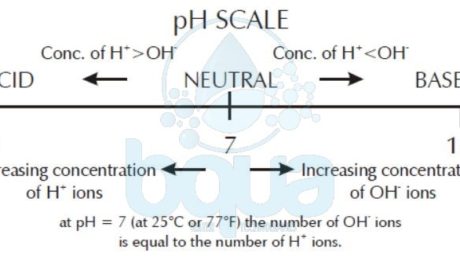
pH refers to the concentration of hydrogen ions in solution. The lower the pH the more hydrogen
ions present. The higher the pH the fewer hydrogen ions present

pH scale: Concentration of Hydrogen ions
The acidity and alkalinity of a solution is extremely important in Reverse Osmosis water treatment due to factors such as membrane degradation, membrane cleaning, etc. This is because certain chemical reactions will only take place at specific pH values.
The term pH is used to describe whether a solution is alkaline or acidic. The concept of acidity and alkalinity may best be described by going back to the dissociation constant.
Looking at the exponent on the concentration of Hydrogen H+ ion, we see that as the H+ concentration goes up (and OH- concentration goes down) we get a smaller negative number. Likewise, as Hydroxide OH- concentration goes up (and H+ concentration goes down) we get a larger negative number.
[H+] x [OH-] = 1.0 x 10^-14
With addition of acid (H+)
1.0 x 10^-5 x 1.0 x 10^-9 = 1.0 x 10^-14
With addition of base (OH-)
1.0 x 10^-9 x 1.0 x 10^-5 = 1.0 x 10^-14
Exponent changes with changes in H+ and OH- concentrations
Taking this into consideration, scientists learned that a more convenient way to describe the hydrogen ion concentration of a solution is to take the negative logarithm of the hydrogen ion concentration. A logarithm is the exponent to which a base number is raised to produce a given number. NOTE: We will usually use a base of 10.
EXAMPLE: The log (logarithm) of 100 is 2: Ten raised to the power of 2 (102).
EXAMPLE: The log of 127 is 2.1 (On a scientific calculator, enter 127, then push the [LOG] key).
| NUMBER | LOG | NUMBER | LOG |
| 1 = 1 X 10^0 | 0 | 1.0 = 1 X 10^0 | 0 |
| 10 = 1 X 10^1 | 1 | 0.1 = 1 X 10^-1 | -1 |
| 100 = 1 X 10^2 | 2 | 0.01 = 1 X 10^-2 | -2 |
| 1000 = 1 X 10^3 | 3 | 0.001 = 1 X 10^-3 | -3 |
| 10000 = 1 X 10^4 | 4 | 0.0001 = 1 X 10^-4 | -4 |
| 100000 = 1 X 10^5 | 5 | 0.00001 = 1 X 10^-5 | -5 |
| 1000000 = 1 X 10^6 | 6 | 0.000001 = 1 X 10^-6 | -6 |
| 10000000 = 1 X 10^7 | 7 | 0.0000001 = 1 X 10^-7 | -7 |
The symbol for the negative log is “p”. Therefore, the negative log of the Hydrogen ion concentration is “pH”. Table below lists several hydrogen ion concentrations, hydroxide concentrations, and the corresponding pH and pOH. Note that a pH of 7 is neutral because the Hydrogen ion concentration [H+] and hydroxide concentration [OH-] are the same. As [H+] increases, pH decreases.
| H+ (mol/L) | OH- (mol/L) | ||||
| Decimal | SN | pH | Decimal | SN | pOH |
| 0.00000000000001 | 1 X 10^-14 | 14 | 1.0 | 1 X 10^0 | 0 |
| 0.0000000000001 | 1 X 10^-13 | 13 | 0.1 | 1 X 10^-1 | 1 |
| 0.000000000001 | 1 X 10^-12 | 12 | 0.01 | 1 X 10^-2 | 2 |
| 0.00000000001 | 1 X 10^-11 | 11 | 0.001 | 1 X 10^-3 | 3 |
| 0.0000000001 | 1 X 10^-10 | 10 | 0.0001 | 1 X 10^-4 | 4 |
| 0.000000001 | 1 X 10^-9 | 9 | 0.00001 | 1 X 10^-5 | 5 |
| 0.00000001 | 1 X 10^-8 | 8 | 0.000001 | 1 X 10^-6 | 6 |
| 0.0000001 | 1 X 10^-7 | 7 | 0.0000001 | 1 X 10^-7 | 7 |
| 0.000001 | 1 X 10^-6 | 6 | 0.00000001 | 1 X 10^-8 | 8 |
| 0.00001 | 1 X 10^-5 | 5 | 0.000000001 | 1 X 10^-9 | 9 |
| 0.0001 | 1 X 10^-4 | 4 | 0.0000000001 | 1 X 10^-10 | 10 |
| 0.001 | 1 X 10^-3 | 3 | 0.00000000001 | 1 X 10^-11 | 11 |
| 0.01 | 1 X 10^-2 | 2 | 0.000000000001 | 1 X 10^-12 | 12 |
| 0.1 | 1 X 10^-1 | 1 | 0.0000000000001 | 1 X 10^-13 | 13 |
| 1.0 | 1 X 10^-0 | 0 | 0.00000000000001 | 1 X 10^-14 | 14 |
