


What is Electronegativity – Electronegativity Definition
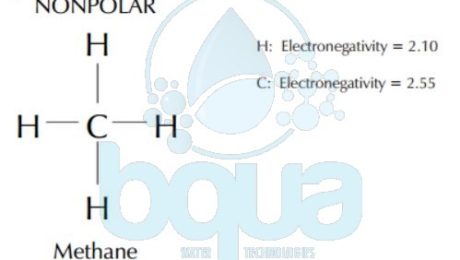
The electronegativity determines whether a bond between two atoms is polar or nonpolar which is defined by Polarity. The electronegativity is a measurement of how attractive an atom is to electrons. The more electronegative an element is, the more the shared electrons will spend around that atom. When one atom in a bond gets to keep the electrons more than the other, it assumes a partial negative charge. The other bonded atom has the electrons less often, so assumes a slight positive charge. Like the negative and positive poles of a magnet. One end of the bond is positive and one end is negative, so the bond is said to be polar. Carbon and hydrogen bonds, as in methane, are nonpolar because the electronegativity of both are very close. Carbon and oxygen bonds are polar because the electronegativity of them are substantially different.

Electronegativity example in Methane molecule
Polar substances dissolve in polar substances because the partial positive & negative charges of one molecule are attracted to the partial +ve and -ve charges of other molecules. Nonpolar substances will dissolve in nonpolar substances. This is because of other forces of attraction, such as Van der Waals’ forces, can come into play. Nonpolar compounds generally do not dissolve in polar compounds, and vice versa, because there is no attraction between things that are charged and things that aren’t. Since water is polar, compounds which are polar will generally dissolve well.
Therefore, if we have an organic which is polar, such as methyl alcohol, it will dissolve well in water. In general, the more polar an organic is, the more it will be dissolved. More importantly for this chapter, the more nonpolar a compound is, the less it will be dissolved and the more it will tend to be a suspended particle.
SIZE: One other aspect of suspended solids is their size. Very large molecules, even if they are polar, will tend to be particles. For example, we have discussed silica (SiO2) at length. If we look at the bonding between Si and O, we see that silicon has an electronegativity of 1.90 and O has an electronegativity of 3.44. Is this a polar bond? Given that water is polar and hydrogen has an electronegativity of 2.10, silica is more polar than water. Yet we see that sand is a particle and not dissolved.
To summarize, then, the degree of polarity and the size of an organic compound will determine if it is suspended or dissolved.
What is Total Suspended Solids – TSS Definition
Total suspended solids (TSS) concentration is a measure of the total weight of solid residuals contained in the source water. It is customarily presented in milligrams per liter or parts per million. Total Suspended Solids can also be defined as a laboratory analysis that measures the weight of suspended solids in a specified volume. It is used to accurately (within the limitations of the test) measure suspended solids concentration. The TSS measurement is the standard method for measuring the weight of suspended solids. The method utilizes a 0.45 micron membrane filter.

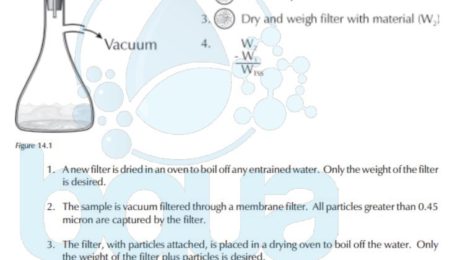
Total Suspended Solids TSS measurement test procedure
Total Suspended Solids is the most accurate standard test for monitoring the amount of suspended material in a sample. The problems with it are:
1. It doesn’t tell us anything about the number of particles.
2. It doesn’t tell us anything about the size of particles.
3. It is only a crude measurement of the fouling potential of the particles.
4. It doesn’t measure any particles less than 0.45 micron in diameter.
Even with its limitations, however, it can be a valuable tool for monitoring the solids loading into a Reverse Osmosis System.
TSS is measured by filtering a known volume of water (typically 1 L) through a preweighed glass-fiber filter. Drying the filter with the solids retained on it at 103 to 105°C, and then weighing the filter again after drying. The difference between the weight of the dried filter and of the clean filter, divided by the volume of the filtered sample. Reflects the total amount of particulate (suspended) solids in the source water.
It should be pointed out that because saline water contains dissolved solids which will crystallize and convert into particulate solids when the sample is heated at 103 to 105°C. Often Total Suspended Solids TSS analysis of saline water completed in accordance with the standard methods. For water and wastewater analysis yields an erroneously high Total Suspended Solids TSS content in the water. The higher the source water’s salinity and the lower its particulate content. The more inaccurate this measurement is. In order to address the challenge associated with the standard method of Total Suspended Solids TSS measurement. It is recommended to wash the solids retained on the filter by spraying the filter with deionized water before drying. Unless the source water solids sample is washed before drying, the results of this sample are meaningless.
The laboratory Total Suspended Solids TSS test is completed properly and the filtered sample is well washed to give us a precise measure. This parameter usually provides a much more accurate measure of the actual content of particulate solids in the source water than does turbidity. Because it accounts for the actual weight of the particulate material present in the sample. For comparison, turbidity measurement is dependent on particle size, shape, and color. And typically is not reflective of particles of very small size (i.e., particles of 0.5 µm or less). Such as fine silt and picoalgae. In fact, a change in the ratio of Total Suspended Solids TSS to turbidity is a good indicator of a shift in the size of particles contained in the source water. Which may be triggered by algal blooms, storms, strong winds, and other similar events. Which can result in resuspension of solids from the bottom sediments into the water column.
Typically, an increase in the Total Suspended Solids/turbidity ratio is indicative of a shift of particulate solids toward smaller-size particles. For example, during non-algal-bloom conditions, the TSS/turbidity ratio of an appropriately processed sample is typically in the range of 1.5 to 2.5. Water with a turbidity of 2 NTU would have a Total Suspended Solids concentration of 3 to 5 mg/L. During heavy algal blooms dominated by small-size (pico- and micro-) algae, the TSS of the source water could increase over 10 times (e.g., to 40 mg/L). While the source water turbidity could be multiplied by 2 to 3 times only. For this example it would be in range of 4 to 6 NTU. With a corresponding increase in the TSS/NTU ratio from 2/1 to between 6/1 and 10/1.
What is Coagulation Definition
Coagulation is simply the process that destabilizes colloidal particles so that they can come together to form larger, conglomerate particles. Low-pressure membrane technology is becoming significantly more prevalent in the drinking water industry. Low-pressure membranes are purely size-exclusionary devices. As a result, anything smaller than membrane pore sizes (approximately 0.01 to 0.1 micron) will pass through the membrane, Therefore, membrane feed waters with dissolved materials, such as organics and metals, require some form of additional treatment.
Often, in these cases, the most economical pre-treatment process is simple coagulation. Potential coagulants for membrane pre-treatment include those also used for conventional water treatment. Additionally, organic adsorption media such as PAC and MIEX, or oxidants such as potassium permanganate, chlorine, or chlorine dioxide can be applied upstream of a low-pressure membrane (assuming appropriate membrane compatibility) for enhanced dissolved material removal.
Similar to a direct filtration mode of operation for conventional technology, the goal of coagulation for membrane pretreatment is to produce a pinpoint floc that is capable of adsorbing dissolved matter, but minimizes solids loading onto the membrane filtration process. As noted briefly above, it is important to quantify membrane compatibility and performance with the coagulant of choice.
Each commercially available RO membrane utilizes different membrane materials. As a result, the compatibility and performance of a coagulant for membrane filtration pre-treatment will likely vary between membrane system and raw water supplies. As such, there are no specific guidelines for membrane system pre coagulation except the general guidelines that are associated with conventional treatment.
Coagulant Types
The coagulant most frequently used for membrane plant source seawater conditioning prior to sedimentation or filtration is ferric salt (ferric sulfate and ferric chloride). Aluminum salts (such as alum or polyaluminum chloride) are not typically used because it is difficult to maintain aluminum concentrations at low levels in dissolved form because aluminum solubility is very pH dependent. Small amounts of aluminum may cause mineral fouling of the downstream Seawater Reverse Osmosis membrane elements. In coagulation, coagulant dosage for a given source water should be determined based on jar test and/or pilot testing. The optimum coagulant dosage in a coagulation process is pH dependent and should be established based on an on-site jar or pilot testing for the site-specific conditions of a given application.
Overdosing of a coagulant used for seawater pretreatment is one of the most frequent causes for SWRO membrane mineral fouling. When overdosed during coagulation, coagulant accumulates on the downstream facilities and can cause fast-rate fouling of downstream cartridge filters following the pretreatment step and in iron fouling of the Seawater RO membranes. The effect of overdosing of coagulant (iron salt) on the SDI level can be recognized by visually inspecting the SDI test filter paper (Figure 6). In such situation, a significant improvement of source water SDI can be attained by reducing coagulant feed dosage or in case of poor mixing, modifying the coagulant mixing system to eliminate the content of unreacted chemical in the filtered seawater fed to the SWRO membrane system.

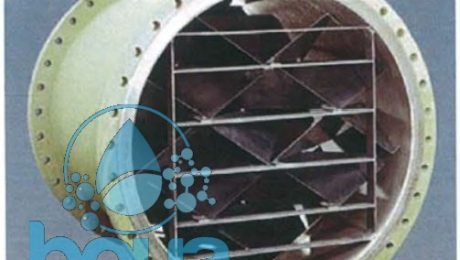
In line static mixer used in coagulation
The main purpose of the coagulation system is to achieve uniform mixing of the added coagulant with the source seawater and efficient coagulation of the particles contained the seawater. The two types of mixing systems most widely used in seawater desalination plant is in line static mixer and mechanical flash mixer installed in coagulation tanks. Although in-line mixers are simple and less costly, they have two disadvantages: (1) their mixing efficiency is a function of the flow rate; (2) static mixers are proprietary equipment and the project designer would need to rely on the equipment manufacturer for performance projections.
Static mixers also create additional head losses of 0.5 to 1.0 meters, which need to be accounted for in the design of the intake pump station. Another important issue is to provide adequate length of pipeline (at least 20 times the pipe diameter) between the mixer and the entrance to the pretreatment filters in order to achieve adequate flocculation. Mechanical flash mixing systems consist of coagulation tank with one or more mechanical mixers and chambers. The coagulation tank is designed for a mixing time (t) of 1 to 3 seconds and mechanical mixers that create velocity gradient (G) of 300 s, (optimum G x t = 500 to 1,600). The power requirement for the mechanical mixer is 2.2 to 2.5 horsepower/10,000 m3/day. This type of mixing usually provides a more reliable and consistent coagulation, especially for desalination plants with significant daily flow variations (i.e., more than 30 % of average annual production flow).
What is Total Organic Carbon – TOC Definition
Total organic carbon is one of the most widely used measures for organic content of seawater. Total Organic Carbon concentration measures the content of both Natural Organic Matter (NOM) and of easily biodegradable organics, such as polysaccharides released during algal blooms. This water quality parameter is widely used, because it is relatively easy to measure. And it is indicative of the tendency of the seawater to cause Seawater Reverse Osmosis System SWRO membrane biofouling. Total Organic Carbon TOC is measured by converting organic carbon to carbon dioxide in high-temperature furnace in the presence of a catalyst.
Typically, open ocean seawater which is not influenced by surface fresh water influx (nearby river confluence). By man-made activities (i.e., wastewater or storm water discharges, or ship traffic). Or by algal bloom event (i.e., red tide), has a very low Total Organic Carbon content ($0.2 mg/L). When an algal bloom occurs however, Total Organic Carbon TOC concentration of the ocean water could increase by an order of magnitude (2 to 8 mg/L). Similar magnitude of Total Organic Carbon (TOC) increase could be triggered by a storm water or river discharge during high-intensity rain event. Such as the rainy seasons in tropical and equatorial parts of the world.
Usually, an increase of Total Organic Carbon above a certain threshold (2.0 to 2.5 mg/L) is observed to trigger accelerated biofouling of Seawater RO membranes. The Carlsbad seawater desalination demonstration plant in California is supplied by seawater collected using near-shore open ocean intake. Observations indicate that Total Organic Carbon concentration in the source water at that location exceeds 2.0 mg/L during algal bloom events. Within a week to two week period, the Seawater Reverse Osmosis system experiences measurable biofouling and associated increase in operating pressure. Similar TOC level observations at the Tampa seawater desalination plant, in Florida, USA (where the typical background TOC level of the seawater is less than 4 mg/L) indicate that accelerated biofouling occurs when Total Organic Carbon concentration exceeds 6 to 8 mg/L.
Usually, accelerated biofouling at the Tampa facility is triggered by one of two key events – rain events, which increase the content of alluvial organics in the source seawater, or algal blooms which cause elevated organic levels due to massive die off of algae. The increase in alluvial organics during rain events is caused by the elevated flow and alluvial content of Alafia River. Which discharges into Tampa Bay several kilometers upstream of the desalination plant intake. During high-intensity rains during summer months, TOC level in the river water discharging in the bay may exceed 20 mg/L.
| Seawater Source | TOC (mg/l) | Polysaccharides (% of Total TOC) |
Humic Substances and Building Blocks (% of Total TOC) |
Low Molecular Weight Acids and Neutrals (% of Total TOC) |
Other Low Molecular Weight Compounds (% of Total TOC) |
| Surface Raw Seawater – Perth, Australia | 0.9 | 3 | 31 | 25 | 41 |
| Surface Raw Seawater -Ashkelon, Israel May 2005) |
1.2 | 14 | 39 | 25 | 22 |
| Surface Raw Seawater -Ashkelon, Israel May 2006) |
1 | 7 | 52 | 22 | 19 |
| Surface Raw Seawater -Carboneras, Spain | 0.9 | 8 | 38 | 18 | 42 |
| Well Seawater – Gibraltar, Spain | 0.6 | 1 | 26 | 22 | 51 |
| Surface Raw Seawater –Gibraltar, Spain | 0.8 | 5 | 26 | 25 | 42 |
Analysis of various sources of seawater indicates that TOC concentration of seawater may contain various fractions of organics. This depends on the origin of this water and the type of seawater intake. See Table above. These fractions may also change depending on the season as well. Analysis of the Table indicates that low-molecular weight organic compounds are typically the greatest fraction of the TOC in seawater (40 to 50%). Comparison of the data from the Ashkelon seawater desalination plant in Israel indicates that the most easily biodegradable organics (polysaccharides) change seasonally. And increase during the summer season along with the content of algal biomass in the ocean. This data also shows that TOC concentration of seawater may not always correlate with the content of polysaccharides in the water.
